SPACE CONSUMERS DESERVE A
SEAT AT THE TABLE
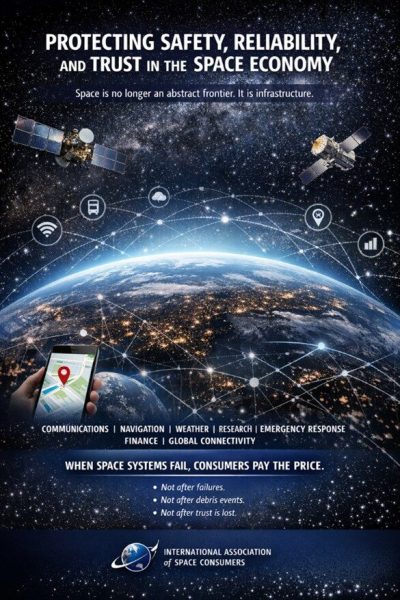
PROTECTING SAFETY, RELIABILITY,
AND TRUST IN THE SPACE ECONOMY
Space is no longer an abstract frontier. It is infrastructure.
Everyday services—communications, navigation, weather forecasting, scientific research, emergency response, financial systems, and global connectivity—now depend on commercial and governmental space activity. When space systems fail, consumers pay the price through service disruption, rising costs, data loss, and degraded scientific access.
The International Association of Space Consumers (IASC) exists to ensure that consumer interests are visible, credible, and technically informed at the point where space policy, governance standards, and operational systems are designed.
Not after failures.
Not after debris events.
Not after trust is lost.

WHAT WE MEAN BY “SPACE CONSUMERS”
A space consumer is any individual, institution, or research community that relies on space-enabled services, including:
- Communications and broadband users
- Navigation and timing dependents
- Scientific and astronomy professionals
- Climate and Earth-observation researchers
- Emergency and disaster-response systems
- Financial and data-dependent industries
Consumers are not passive. They are system stakeholders—and their interests must be represented upstream, where decisions are still reversible.
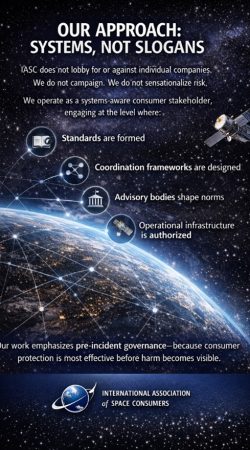
OUR APPROACH: SYSTEMS, NOT SLOGANS
IASC does not lobby for or against individual companies.
We do not campaign.
We do not sensationalize risk.
We operate as a systems-aware consumer stakeholder, engaging at the level where:
- Standards are formed
- Coordination frameworks are designed
- Advisory bodies shape norms
- Operational infrastructure is authorized
Our work emphasizes pre-incident governance—because consumer protection is most effective before harm becomes visible.
WHY THIS MATTERS NOW
Commercial space activity is accelerating faster than its governance frameworks.
- Orbital congestion is increasing
- Collision risk is measurable and rising
- Debris externalities threaten long-term access
- Licensing and coordination gaps create systemic risk
Once space infrastructure becomes unstable, consumer harm is unavoidable and expensive to reverse.
The knowledge exists. The risk is mapped. The policy window is open.
WHAT WE DO
LEGISLATIVE & POLICY
We analyze and engage with space-related legislation at the federal level, focusing on consumer-relevant impacts such as safety, reliability, cost stability, and scientific continuity.
TECHNICAL & GOVERNANCE
Translating complex space systems, traffic coordination, situational awareness and licensing frameworks into consumer-relevant models for policymakers and professionals.
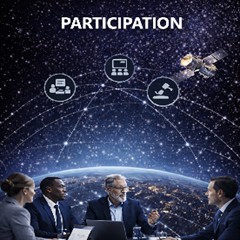
PARTICIPATION
We engage advisory bodies, committees, and institutional stakeholders before incidents force reactive regulation.
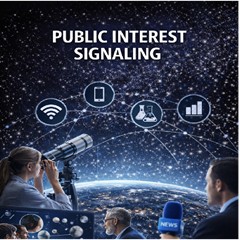
PUBLIC INTEREST SIGNALING
We help decision-makers understand that consumer protection in space is not ideological—it is a design requirement.
WHAT MAKES IASC DIFFERENT
• Non-Partisan — competence over ideology
• Non-Activist — analysis over outrage
• Industry-Literate — systems over blame
• Consumer-Defensible — safety, trust, and continuity first
We speak the language policymakers, regulators, scientists, and operators already use—because credibility is the entry ticket.
CURRENT FOCUS AREAS
- Space traffic coordination and collision risk
- Orbital debris and long-term sustainability
- Licensing and market access integrity
- Advisory governance and standards formation
- Consumer transparency and trust mechanisms
ENGAGE WITH US
If you are a:
- Consumer
- Policymaker
- Researcher
- Scientist
- Industry participant
- Journalist
We welcome serious, systems-level dialogue.